
All About Lavender Oil
Published by New Directions Aromatics on 1st Apr 2026
April 7, 2017
All About Lavender Oil
Lavender oil is known for its calming and balancing effects, widely used in cosmetic, aromatic, and medicinal products. Its quality depends on plant species and growing conditions, with the best oil made from steam-distilled fresh flowers. It should be used with caution, especially during pregnancy, when taking sedative medications, or before anesthesia.
History of Lavender Oil
Lavandula angustifolia, better known as Lavender, is a perennial evergreen plant that has produced the most used essential oil in the world for over 2500 years. Thriving in oceanic climates with dry, rocky, sandy terrain, Lavender can be found in the Mediterranean region, Europe, Africa, the Canary Islands, the Middle East, and India.
The name Lavender is believed to be derived from the Latin word “lavare,” meaning “to wash,” as it was often used in baths and laundry for its fragrant properties. With a calming, physically and emotionally balancing fragrance, it has commonly been used for its relaxing effects on the body. According to ancient texts, its purposes range from medicinal to religious, having been used to clean cuts and to soothe bruises and skin irritations, as well as to scent the air for spiritual practices. Other historical uses for this oil included mummification and perfumery for the Egyptians, while for the Romans it was used in baths and in cooking.
Benefits of Lavender Essential Oil
Used medicinally, lavender essential oil has been found to eliminate harmful bacteria, relieve muscle spasms, reduce flatulence, disinfect and soothe inflamed skin (especially from venomous or itchy bug bites), promote faster healing of irritated and scarred skin, and relieve muscle tension when used in massage.
In aromatherapy, this mild sedative is known to reduce stress by relaxing brain waves and lowering cortisol levels (the stress hormone). By reducing cortisol, lavender may also support the immune system. It is believed to help balance hormones, ease nervous tension, and—based on some evidence—reduce feelings of depression in certain individuals. Due to its calming properties, it is also commonly used as a sleep aid for insomnia.
Therapeutic Properties of Lavender Essential Oil
COSMETIC:
Anti-septic, anti-inflammatory, deodorant, relieving, soothing, cytophylactic, cicatrisant.
ODOROUS:
Anti-depressant, anti-rheumatic, anti-spasmodic, decongestant, deodorant, relaxing, sedative, soothing, nervine.
MEDICINAL:
Anti-septic, analgesic, anti-convulsant, anti-depressant, anti-rheumatic, anti-spasmodic, anti-inflammatory, anti-viral, bactericidal, decongestant, relieving, soothing, vulnerary, sudorific, rubefacient, hypotensive, emmenagogue, diuretic, cytophylactic, cicatrisant, carminative.
Cultivating and Harvesting Quality Lavender Essential Oil
Lavender plant growing conditions play a significant role in determining the quality of the distilled essential oil. Factors such as season, climate, moisture levels, and even cloud coverage can influence the final product, as not all lavender varieties thrive in every environment. Soil quality is especially important—high nitrogen levels, for example, can promote disease, resulting in weak plants and reduced flower production.
Delicate, or “tender,” varieties of lavender require warmer conditions and cannot survive outdoors during winter. These types should be potted and kept indoors in sunny areas with good air circulation. While lavender can tolerate heavy rainfall, proper drainage is essential, as the plant thrives best in dry, hot, and sunny conditions. High humidity can lead to fungal growth, making adequate airflow crucial for healthy development.
It is also important to distinguish between natural and synthetic lavender oils. Synthetic lavender fragrances, created in laboratories to mimic the natural scent, are generally of lower quality. This is due to differences in molecular structure—only pure, naturally derived lavender essential oil contains the beneficial volatile compounds responsible for its therapeutic properties.
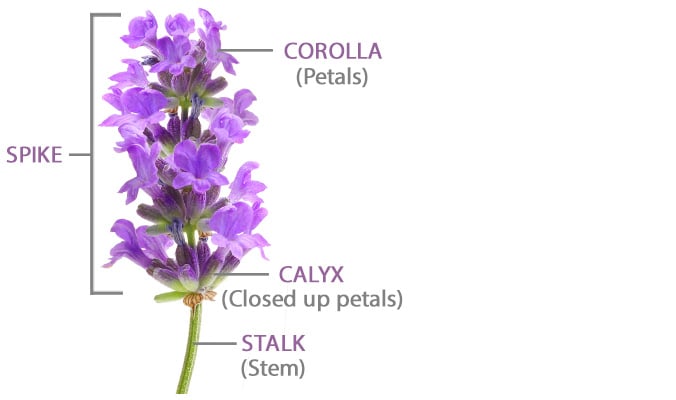
Lavender flowers vary in shape and size and typically grow on long stems or spikes. Essential oils are found in microscopic glands located on the outer petals (calyx), inner petals (corolla), as well as in the leaves, stalks, and branches. Lavender flowers go through several stages of development, and the ideal time for harvesting is when they are in full bloom. At this stage, the top flowers have opened, the lower ones are beginning to bloom, and most of the flower head is fully developed.
Harvesting lavender too early can result in lower-quality oil, while waiting too long causes the flowers to dry out and lose their volatile compounds, leading to a weaker fragrance. Timing the harvest correctly is key to producing high-quality lavender essential oil.
Please refer to the image below for the flower parts mentioned above.
The yield and the quality of the oil depends on the age of the Lavender bushes as well as the weather. The months of harvest are between the end of July through August and may take between four and ten days, after which the quality could diminish. It is important to plan a harvest at a time when the weather is the perfect balance – that is, bright and clear but not hot, cold, or too windy. Some of these conditions would cause the oils to evaporate while others would inhibit the esters from developing in the plant, which would lead to harvest being delayed until the onset of warmer weather. The absence of esters in Lavender oil would mean that the oil would lose its fragrant and therapeutic properties such as its sedative and anti-spasmodic effects.
If harvested by hand, Lavender flower spikes can be cut using sickles or shears. If harvested commercially through a mechanized process, harvesters are driven through Lavender fields with blooming flowers and the stems are cut while the flowers are stored in a cart that will be taken to a distillery. Some harvesting machine models feed the flowers into cartridges that can fit directly into the distiller, which contributes to a faster pace for harvesting. After being picked, the Lavender is distilled.
Lavender essential oil quality depends on ideal growing conditions, proper care, and harvesting the flowers at full bloom to preserve their potent fragrance and therapeutic benefits.
How Is Lavender Essential Oil Extracted?
The distillation part of the production process determines the oil’s value, due to the fact that the pressure or temperatures applied to the flowers during the distillation process could potentially alter the structure of the fragrance molecules and thus change the oil’s chemical constituents. If the oil comes in contact with free water during the preheating stage of distillation, the oil quality and the efficiency of extraction may both be weakened.
The highest quality essential oil is derived from steam distilling only the fresh Lavender flowers and no other part of the plant. It is believed that the first distillation produces an oil that is clear and of the highest quality. The second distillation is believed to produce oil of a pale amber colour and a strong scent that is less pleasant than the first oil. When selecting a Lavender essential oil, it is more relevant to consider a company’s complete essential oil production process from field harvest to the bottling of the final product.
Uses of Lavender Essential Oil
he uses for Lavender essential oil are abundant, ranging from medicinal and odorous to cosmetic. Its many forms include oils, gels, lotions, soaps, shampoos, sprays, and candle making.
Used in aromatherapy, the fragrance is inhaled and scent receptors in the brain’s emotional powerhouse process the smell as calming, allowing the brain and body to relax. Similarly, a few drops smoothed onto a pillow may promote faster onset of deeper sleep with a decreased number of sleep disturbances. Its ability to reduce emotional stress such as anxiety and its potency in alleviating headaches also extends to its ability to reduce feelings of motion sickness and to improve the mood. It is believed that Lavender can reduce symptoms of hay fever when inhaled deeply.
Diluted with a carrier oil and used topically, Lavender oil moisturizes chapped and aging skin. Its anti-septic and anti-fungal properties may help to reduce itching and swelling caused by insect bites. Known to have anti-microbial properties, it provides soothing relief to minor burns and cuts, decreasing pain and inhibiting bleeding while eliminating bacteria from the wound. Its potential to restore skin complexion is also demonstrated with use on aging and acne-prone skin on which it slows the look of aging with its powerful anti-oxidant action and improves the look and feel of skin that is subject to eczema and psoriasis. In hair care, Lavender is known to be an anti-septic that effectively eliminates lice, nits, and dandruff when rubbed into the scalp.
As a spray, Lavender acts as a natural perfume and a non-toxic air freshener that creates a relaxing atmosphere, especially for the bedroom. In the bathroom, it can be sprayed onto towels for a fresh and calming scent.
A Guide to Lavender Essential Oil Varieties & Their Benefits
There are over 30 species of Lavender and hundreds of genotypes that are distinguished by their growth form and the chemical compositions of their essential oils. There are 3 main species of Lavender that fall within the genus that produces essential oils. They belong to a group called “Lavendula” and they are: English Lavender (Lavendula angustifolia) and Spike Lavender (Lavendula latifolia). The chemical composition of Lavender essential oil consists of over 100 constituents including: linalool, linalyl acetate, camphor, limonene, cineole, tannins, coumarins, flavonoids, triterpenes, and perillyl alcohol. The main ones are 1,8-cineole, limonene, linalool, camphor, linalyl acetate, lavendulyl acetate, terpinen-4-ol, a-pinene, cis-ocimene, 3-octanone, trans-ocimene, and caryophyllene. The following chart highlights the most popular varieties of Lavender oil and their botanical names, countries of origin, and their benefits:
Here’s a clean, structured, blog-ready version you can copy and paste:
Lavender Varieties & Their Benefits
Lavender Organic
Lavandula angustifolia
Found in:
Bulgaria, Spain, France, Italy, Croatia, South Africa
Believed to:
-
Be anti-inflammatory
-
Be calming
-
Relieve headaches
-
Support immunity
-
Be sedative
-
Promote skin healing
Lavender Bulgarian (English Lavender)
Lavandula angustifolia
Found in:
Bulgaria
Believed to:
-
Be a relaxant
-
Reduce stress
-
Relieve headaches
-
Improve joint pain
Lavender Population (Fine Population)
Lavandula angustifolia
Found in:
France
Believed to:
-
Help reduce coughs and colds
-
Promote easier breathing
-
Ease anxiety and insomnia
Lavender Spanish (Butterfly Lavender)
Lavandula stoechas
Found in:
Spain, North-West Africa, Madeira Islands, Canary Islands, Southern Europe, Western Asia
Believed to:
-
Act as a cold remedy
-
Increase mental clarity
-
Reduce fatigue
-
Improve mood
Lavender (Natural Blend) Essential Oil
Found in:
France
Description:
-
A blend of lavender oils from various regions and sources
-
Created to offer a more economical option
Key Features:
-
Not therapeutic grade but fully natural
-
Free from synthetic ingredients and aromatic compounds
-
Contains no artificial fragrances or colorants
-
Suitable for natural product formulations
-
Ideal for fragrancing cosmetic products
Lavender 40/42
Lavandula officinalis
Found in:
France
About 40/42:
-
Refers to the standardized ratio of key compounds: linalool and linalyl acetate
Key Features:
-
Made from 100% natural constituents
-
Blended for consistent floral aroma
-
Commonly used in soaps, candles, perfumes, and cosmetics
Lavender Floral Water
Lavandula angustifolia
Description:
-
Contains water-soluble plant compounds remaining after distillation
Uses:
-
Can be used on its own
-
Acts as a base for cosmetic formulations
-
Suitable for making natural air fresheners
Contraindications for Lavender Essential Oil
As per NAHA guidelines, New Directions Aromatics (NDA) does not recommend the ingestion of essential oils. Lavender Oil can potentially increase the effectiveness of medications such as those related to sleep disorders or those prescribed for depression and the same advice applies for any cough or flu medicine that induces sleep, as Lavender Oil stimulates drowsiness. It is best to avoid using Lavender Oil when undergoing surgery or anesthesia.
There is not enough research to prove that this oil is safe to use at any stage of pregnancy, as it can act as a muscle relaxant and can affect hormone levels; therefore, pregnant and nursing women are advised not to use Lavender Oil, especially pregnant women in their third trimester, unless a medical practitioner is consulted first. Despite being considered generally safe for children to use, the effects of Lavender Oil on hormones means it could potentially be harmful to pre-pubescent boys. Parents are advised to exercise caution when using it on children in this age range.